141. Linked List Cycle
04 Jul 2024
141. Linked List Cycle (Easy) 环形链表
题干
Given head, the head of a linked list, determine if the linked list has a cycle in it.
There is a cycle in a linked list if there is some node in the list that can be reached again by continuously following the next pointer. Internally, pos is used to denote the index of the node that tail’s next pointer is connected to. Note that pos is not passed as a parameter.
Return true if there is a cycle in the linked list. Otherwise, return false.
Example 1:
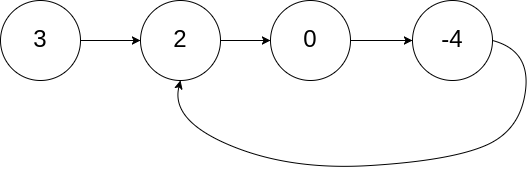
Input: head = [3,2,0,-4], pos = 1
Output: true
Explanation: There is a cycle in the linked list, where the tail connects to the 1st node (0-indexed).
Example 2:
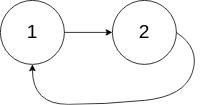
Input: head = [1,2], pos = 0
Output: true
Explanation: There is a cycle in the linked list, where the tail connects to the 0th node.
Example 3:

Input: head = [1], pos = -1
Output: false
Explanation: There is no cycle in the linked list.
Constraints:
- The number of the nodes in the list is in the range
[0, 104]. -105 <= Node.val <= 105posis-1or a valid index in the linked-list.
Follow up: Can you solve it using O(1) (i.e. constant) memory?
解法
朴素解法
使用一个备忘录,记录每个节点,若后面有重复,即节点存入前,节点已经存在。那么就有环形存在
# Definition for singly-linked list.
# class ListNode:
#     def __init__(self, x):
#         self.val = x
#         self.next = None

class Solution:
    def hasCycle(self, head: Optional[ListNode]) -> bool:
        temp: List[ListNode] = []
        while head is not None:
            if head in temp:
                return True
            temp.append(head)
            head = head.next
        return False
- Time Cost: O(n^2)
- Space Cost: O(n)
优化解法
基于朴素解法,只是数据结构换成了dict
# Definition for singly-linked list.
# class ListNode:
#     def __init__(self, x):
#         self.val = x
#         self.next = None

class Solution:
    def hasCycle(self, head: Optional[ListNode]) -> bool:
        temp: Dict[ListNode, int] = {}
        while head is not None:
            if head in temp:
                return True
            temp[head] = 0
            head = head.next
        return False